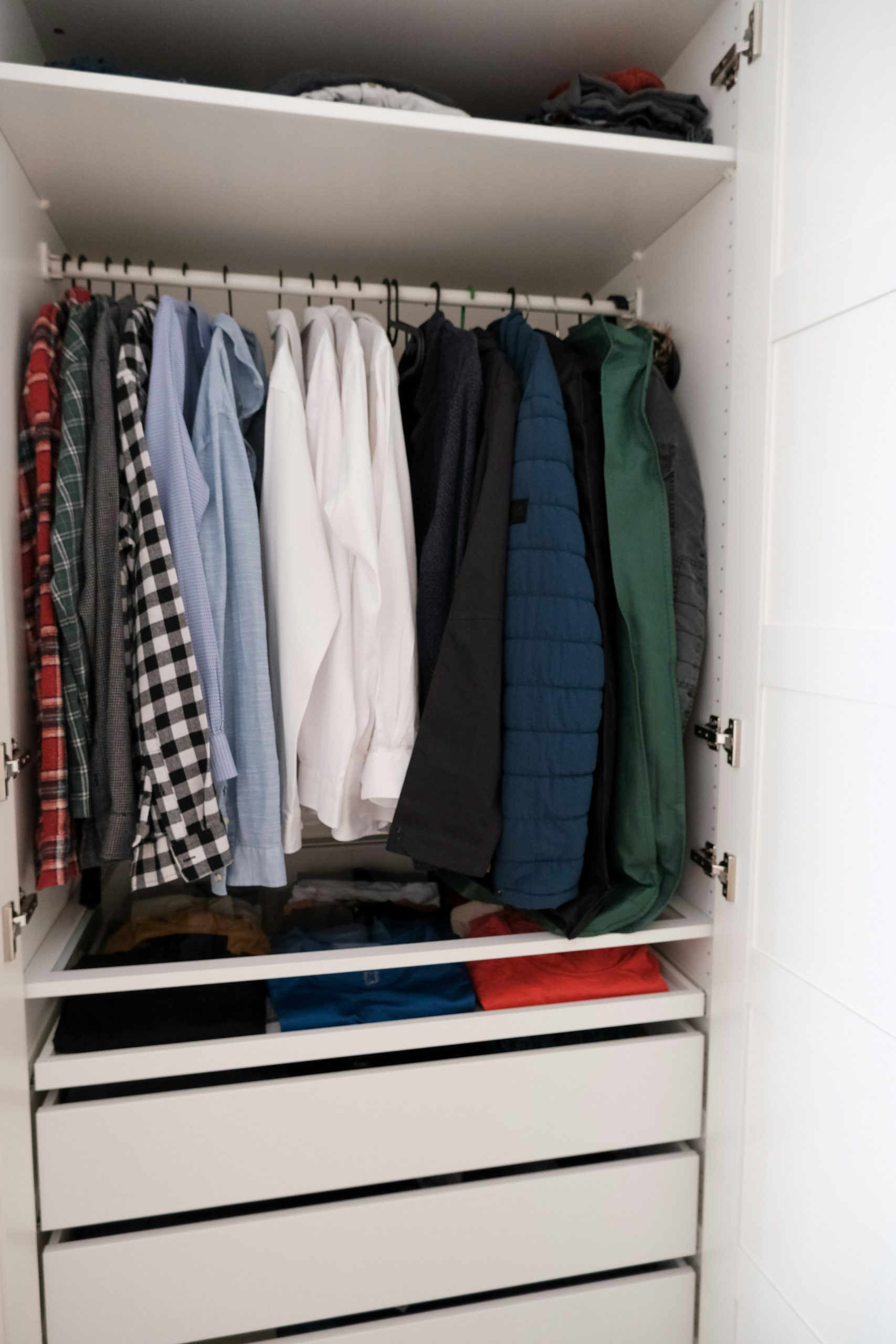
A small closet doesn’t need an expensive makeover to become easier to use.
In fact, buying more boxes, shelves, and organizers before figuring out what is actually taking up your space can make a small closet even more frustrating.
The better approach is to use the space you already have first, then spend money only where a cheap addition solves a specific problem.
This guide walks you through a simple system for organizing a small closet on a budget in order to maximize small closet space, whether you’re working with a tiny bedroom closet, a cramped reach-in closet, or a rental where you can’t make permanent changes.
The Best Way to Organize a Small Closet
Before buying anything, use this order:
1. Remove what you don’t need.
2. Measure and understand the space.
3. Use the existing vertical space.
4. Make hanging space more efficient.
5. Move rarely used items somewhere else.
6. Buy inexpensive storage only for the problems that remain.
This order matters.
A $20 organizer cannot create space if half of your closet is occupied by clothes you never wear.
1. Empty the Closet Before You Buy Anything
This is the least exciting step, but probably the one that can save you the most money.
Take everything out of the closet and divide it into four groups:
Keep
You use it and it deserves space in the closet.
Move
You want to keep it, but it doesn’t need to live in this closet.
Think seasonal clothing, luggage, special-occasion items, or things you rarely use.
Donate or sell
You don’t use it and don’t realistically expect to.
Repair or decide later
Items you’re genuinely unsure about.
The important part is not to turn “decide later” into a permanent fifth category.
Give yourself a limit. If something has been sitting in your “maybe” pile for months, it probably doesn’t deserve premium closet space.
Budget impact: $0
And that’s exactly why we do it first.
2. Measure Your Closet Before Buying Storage
A small closet is a three-dimensional space, not just a rod full of clothes.
Measure:
- Width
- Depth
- Height
- Distance from the rod to the shelf
- Available floor space
- Door space
You don’t need professional equipment.
A tape measure and a piece of paper are enough.
Write the measurements down.
This prevents one of the most common small-closet mistakes:
buying an organizer first and discovering that it doesn’t actually fit.
A simple rule
Don’t buy an organizer because it looks useful online.
Buy it because you have identified a specific space that needs it.
3. Use the Vertical Space You’re Ignoring
This is where a small closet can gain a surprising amount of usable storage.
Look at the space:
above your clothes
below your clothes
between hanging sections
behind the door
A closet with one hanging rod and a shelf above it may have plenty of unused vertical space.
Instead of automatically installing expensive shelving, consider inexpensive options such as:
- hanging shelves;
- stackable boxes;
- shelf dividers;
- a second hanging level where appropriate.
The goal isn’t to fill every centimeter.
The goal is to make previously wasted space useful.
4. Double Your Hanging Space Where It Makes Sense
If your closet has plenty of vertical clearance, a second hanging level can be one of the highest-impact changes you make.
For example:
Upper rod → shirts, jackets and shorter garments
Lower rod → pants, skirts and other shorter garments
A second rod only makes sense where the clothing below it won’t interfere with the floor or other storage.
You don’t necessarily need a permanent closet renovation.
Depending on the closet, a removable hanging solution can be a practical option, particularly for renters.
Before buying one
Measure the vertical clearance first.
This is a boring step.
Do it anyway.
5. Switch to Slim Hangers—But Don’t Replace Everything Automatically
Slim hangers can reduce the horizontal space each garment occupies compared with bulkier hangers.
That can be useful when the hanging rod is your main bottleneck.
But don’t fall into the organization trap of buying 100 matching hangers just because a Pinterest photo looks good.
Start with the clothes that take up the most space.
Replace a small batch.
Then see whether the extra room is actually useful.
The goal isn’t matching hangers.
The goal is fitting your clothes comfortably.
And if your current hangers already work well, spending money replacing them isn’t automatically an improvement.
6. Put Shoes Where They’re Stealing the Least Valuable Space
Shoes often turn the floor of a small closet into dead space.
Instead of throwing every pair into a pile, decide how much floor space shoes are actually allowed to use.
Depending on the closet, inexpensive solutions include:
Over-the-door organizers
Useful when the door has sufficient clearance.
Vertical shoe racks
Useful when you have more floor height than floor width.
Shoe boxes
Useful for pairs you don’t wear frequently.
Under-bed storage
Useful for seasonal or rarely worn footwear.
The cheapest solution may be the one that uses something you already own.
7. Use the Closet Door
The inside of the closet door is easy to forget because it isn’t part of the main storage system.
That makes it valuable.
A suitable over-the-door organizer can hold:
- shoes;
- belts;
- scarves;
- small accessories;
- bags;
- cleaning or maintenance supplies, depending on the closet.
Before installing anything, check that:
the door can close properly
and
the added weight won’t damage the door or hinges.
For renters, removable options are especially useful because they don’t require permanent modifications.
8. Stop Folding Things Just Because That’s How You’ve Always Done It
Storage should follow the shape of the space.
If a shelf is deep and items stacked on top of one another disappear, try arranging them so you can see what you own more easily.
For smaller garments, vertical folding can make the contents of drawers or bins easier to see.
For bulky sweaters, however, avoid creating unstable towers simply because they look tidy.
A good organization system has one test:
Can you get what you want without destroying everything around it?
If the answer is no, the system isn’t working.
9. Use Boxes You Already Have Before Buying Storage Bins
This is where a genuinely budget-friendly makeover differs from a shopping list.
Before buying matching containers, look around your home.
You may already have:
- shoeboxes;
- small cardboard boxes;
- baskets;
- unused containers;
- bags suitable for seasonal storage.
You can use these to test your layout.
Here’s the trick:
Don’t buy the final storage solution until you’ve tested the system.
If a cardboard box works perfectly for six weeks, then you can decide whether a nicer container is worth the money.
You’re buying storage because you’ve proved you need it—not because an online store told you that you do.
10. Move Seasonal Clothing Out of Prime Closet Space
Your closet’s easiest-to-reach areas are valuable.
Don’t waste them on clothes you won’t wear for several months.
Depending on your home, seasonal items can be stored in:
- under-bed containers;
- vacuum storage bags when appropriate for the garment;
- labeled boxes;
- another closet;
- suitable storage furniture.
Then rotate the clothes when the season changes.
This creates a useful principle:
Your closet should prioritize what you use now, not everything you own.
The $0 Small Closet Reset
Before spending anything, try this:
Step 1
Empty the closet.
Step 2
Remove clothes you no longer use.
Step 3
Move seasonal items elsewhere.
Step 4
Group similar items.
Step 5
Put frequently used clothing in the easiest-to-reach areas.
Step 6
Use existing boxes or baskets to test storage.
Step 7
Only then identify what the closet is still missing.
You may discover that you don’t need half the products you were planning to buy.
A Budget-Friendly Shopping Plan
Once you’ve reorganized the closet using what you already have, give yourself a spending limit.
Here’s a simple way to approach it:
| Budget | Focus |
|---|---|
| $0 | Declutter, rearrange, reuse existing storage |
| Under $25 | Hangers, small dividers or one targeted organizer |
| $25–50 | Add vertical storage or shoe organization |
| $50–100 | Combine several small improvements |
| $100+ | Consider whether a larger modular system is genuinely necessary |
These aren’t universal prices—they’re simply useful budget tiers.
Prices vary by country and product, so don’t treat them as promises.
The important principle is:
Spend more only when the additional storage solves a problem that cheaper options cannot.
Recent budget-oriented closet guides are increasingly using exactly this kind of tiered approach, including renter-friendly and no-drill solutions.
What NOT to Buy First
A small closet can become more cluttered after an organization shopping spree.
Avoid buying these automatically:
Ten different baskets
If you haven’t determined what they will contain, they’re just additional objects.
Huge matching storage sets
They look great in photos but can waste space when their dimensions don’t match your closet.
Bulky hangers
Aesthetic doesn’t matter if they consume your entire hanging rod.
Organizers that only solve a visual problem
A closet isn’t successful because it looks good in one photograph.
It is successful when you can actually use it.
The Most Common Small Closet Organization Mistakes
Mistake 1: Buying storage before decluttering
You’re paying to store things you don’t use.
Mistake 2: Using only the floor
Small closets need vertical thinking.
Mistake 3: Keeping everything in the easiest-to-reach area
Rarely used items shouldn’t occupy prime real estate.
Mistake 4: Creating storage that’s difficult to access
A perfectly organized box that requires removing five other boxes isn’t actually convenient.
Mistake 5: Trying to make everything look identical
Function comes before aesthetics.
Mistake 6: Filling every available centimeter
Empty space isn’t wasted space if it makes the closet easier to use.
A Simple Layout for a Small Bedroom Closet
For a typical small reach-in closet, you can start with this arrangement:
Eye level
Most frequently worn clothes.
Upper shelf
Folded clothing and less frequently used items.
Lower section
Shoes or additional hanging clothes.
Door
Small accessories or shoes where appropriate.
Outside the closet
Seasonal and rarely used items.
The exact arrangement will depend on your closet dimensions.
The best layout is the one that reduces the amount of movement required to use your everyday clothes.
How to Keep Your Small Closet Organized
The first organization session is easy.
Keeping it organized is the real challenge.
Try a five-minute reset once a week:
Hang anything that has been left out.
Return shoes to their place.
Put accessories back.
Remove anything that doesn’t belong.
Check whether a category is getting overcrowded.
Don’t wait for the closet to become a disaster before doing another massive reorganization.
Small corrections are much easier than complete resets.
FAQ
How do I organize a very small closet?
Start by removing unused and seasonal items, then use vertical space, efficient hanging solutions and the closet door. Only buy storage after identifying a specific space problem.
How can I organize a small closet without spending money?
Declutter first, rearrange your existing storage, reuse boxes and baskets, and move rarely used items elsewhere. You can often make a noticeable difference before buying anything.
What is the best way to maximize a small closet?
Use the entire height of the closet rather than relying only on a single hanging rod and the floor. Depending on the layout, a second hanging level, shelf organizers or door storage can make previously unused space functional.
Are slim hangers worth it for a small closet?
They can be useful when hanging space is the main limitation, because slimmer hangers can allow garments to occupy less horizontal space. But replacing working hangers is not automatically worth the cost.
How do I organize a small closet as a renter?
Prioritize removable solutions such as hanging organizers, tension-based storage where appropriate, over-the-door systems and freestanding pieces. Avoid drilling or permanent modifications unless your lease allows them.
How much should I spend organizing a small closet?
There is no universal amount. Start with a $0 reset and only spend money on the specific storage problems that remain. A bigger budget doesn’t automatically produce a better-organized closet.
Final Thoughts
Organizing a small closet isn’t really a storage-shopping problem.
It’s a space-allocation problem.
Give the easiest space to the things you use most. Move seasonal items somewhere else. Use vertical space before expanding sideways. Reuse containers before buying new ones. And only spend money when you can identify exactly what the purchase will fix.
A small closet doesn’t need to become a picture-perfect custom wardrobe.
It needs to become easy to use, easy to maintain, and affordable to improve.nal, clean, and stress-free all year round.